Wednesday, 14 December 2011

Jilly the Jellyfish performs up a storm

Today I was lucky enough to accompany a fantastic Bamboozle crew to 4 performances of Jilly the Jellyfish to pmld kids in a Northampton Special Needs school.

I was impressed by the speed of the "get up" - about an hour to assemble Jelly fish, costumes and props.



The session began with a name song in a circle outside of the jellyfish (re-inforcing that notion of airlock between "normal reality" and the magic of the performance space that we had observed with Oily Cart.
The children were then asked who would like to "lead the way in" - which always elicited an enthusiastic volunteer.
The performance began with a simple introductory song "Swimming, swaying under the sea" - the children were encouraged to enjoy the sensory and moving qualities available inside the tent - including marvellous jellyfish attached to slinkies which achieved some great moves and which the children could set swinging themselves.
Jilly the Jellyfish then emerged in a lovely surprise from a camouflage pile of seaweed and introduced herself to each child.

Meanwhile the other performer slipped on an anenome puppet
 the puppet had a very playful quality and could interact with children from closer or further, it was curious and able to build a relationship with each individual according to their comfort level and communication styles. It certainly was excellent at engaging. A second anenome puppet appeared from outside the tent and this was again a lovely surprise for those inside the tent.

Then followed the exciting event of the storm - achieved by the high powered air blower, which was directed at each child in turn while the following was sung - The storm blew x away heave away haul away.

The children loved this!!!!!!!!!!!!!!

Following the storm was a blackout prefigured and spoken about and a more contemplative mood while Jellyfish lit by black light danced slowly to each audience member before dancing off.

Then an end song - Jilly the Jellyfish followed by a goodbye song where the children exited being serenaded by name.

Very simple, very effective - a deliberate choice on Bamboozle's part to return to a pared back format for pmld audience. The show lasted just over half and hour.

The performers (including musician Skats) all said that they love this kind of work. Skats mused that he would do it full time if he could - that he found it the most satisfying of all his work. What is it about it that is satisfying - I wanted to hear his answer (because this is also how I feel) - ...
He said perhaps it's because you get to connect with people that are hard to connect with and that you feel you make a difference, that this is most human. He said he can also enjoy playing music at a gig and feeling like you are in the zone, connecting with mainstream audience, but there was something about the other connection (with pmld or SEN children) that felt more satisfying. Perhaps the difference is that the ego is less present in this work I suggested to him - Hmm - yes - perhaps that's it ... it's like you don't need the applause to feel good.


Wednesday, 7 December 2011

BAG BOOKS - December 5th

Today our last day in London was visit to Bag Books HQ in Clapham - a charity which creates be-spoke sensory books especially for children with learning difficulties and profound and multiple learning disabilities. http://www.bagbooks.org/
The workshop Manger Sophie Baker , trained in fine arts with experienc in set design and carnival(festival parade) workshops leads a team of experienced "craft artists" and volunteers who hand make each book.


We had first come across Bag Books in the Carson Street Library and Bec Bradley and Francis had read a couple of the stories to a class of students. We had throught to make our own bag-style- book resource to accompany the performance of the Jub Jub Tree. During the residency it became apparent that this was not as simple as it had first appeared and we ran out of time. It felt surreal to be entering their workshop in real life!!!!

We were lucky to come in on a day when they were inducting some other new volunteers, so not only did we get to spend time n the workshop but we also heard from the CEO about funding and witnessed the telling of a brand new story Aladdin.

We learnt from Services Manager Stuart Cummings, Workshop Manager Sophie Baker and craft artist (of 8yrs) Magda about some of the considerations that go into choosing what elements are created for each page. Some principles:
Affordability
Ease
Durability
Safety
Repeatabiltiy( sure supply)
Time (goes with affordabilty and ease)


We were curious as to how books were developed - were they written first and then designed - or the other way around??? The answer it seems was both. Of the three recent new books - One had been written first(by Stuart Cummings) and then designed - and the other tow which had been written and designed by Sophie and Magda respectively had taken their impetus from a more "making" place. We asked " were there many books - that were adaptations of other books or stories?" - and the answer was not as many. For example there was an adaptation of Roald Dahl's Matilda - but this was very long with many pages and expensive to produce. (Hmmm - I remember the difficulty to reduce Jub Jub to 15 "pages")


In general stories worked well when they had 8-12 "pages" and one to two sentences corresponding with each page. Audiences tended to be between 6-12 also.

Bag Books was funded (this was part of Stuart's role) to train storytellers, teachers and librarians to be confident to use the books with pmld children.

It was fantastic to see the range of books and the different ideas for different pages. We got very excited about these small sensor pad things - which could record different sounds (they had recorded a squeaky door for the ghost train in the Fairground story)


As CEO Dean explained - each book is sold for around 30% of it's actual cost - and books take an average of 8 hrs to create. Book sales are only 15% of their annual income - the rest comes from charitable foundations, Lottery, Corporate and individual donations.

Lis'nTell - Louise Coigley

We were excited to be meeting with Lousie Coigley from Lis'n Tell www.lisntell.com as we knew that she was a profound teacher for both Amber Onat Gregory and Lucy Garland, early on in their learning journeys.

She is indeed a special lady, 25years of deep experience in the field of "live inclusive storytelling" with a particular fluency with pmld kids. her original training was a speech therapist, which also gives her a different starting point, although her experiences have also ventured into drama facilitation and training, storytelling and many other things.

Our conversation ranged far and wide from Steiner and his work on the 12 senses, to intentional communities( she lived in one for 6 years that included many adults and children with profound disabilities and was in fact set up for this group). Another topic of deep interest was the issue of choice and active participation of pmld kids in the storytelling experience - her term "Spontaneous Intentional Participation"  which she explained is what often happens when we give the children the space to have their own response - not guided, or prompted or even worse forced by us. How much more meaningful and transformative this is. We explained our experience at Carson Street School - the "embedding process" of familiarising the students with story elements, character and environment and talked about the positive effect of that on children's audience participation and also the level of feedback that performers then experience during the show.  She perceptively commented that perhaps the "embedding process" had an equal effect on the performers which is so true. It once again made me appreciate the wisdom of Ros Hamling's "hasten slowly'.

We showed her a dvd of the Jub Jub performance and asked for critical feedback.

She encouraged us to think about slowing the pace of the words even further - without doing that artificial T-H-E C-A-T S-A-T O-N T-H-E M-A-T thing. The way to slow the words without losing focus and expression is to carry the meaning of the words through full embodiment. In many ways - I was shocked in fact to recognise how we had not done that in our performance. Any way it felt like a light bulb moment and something to work with upon our return - bringing in my physical theatre and movement experience.

She also encouraged us to think of the ritual aspects of the performance - to make each of the moments of "water pouring" - To give a kind of gravitas and beauty to these moments.

We talked about the quality of mutuality that can be achieved between performer and audience member and that this mutuality was necessary for the work to translate - that this is part of its "JAZZ nature" - improvising around deep structure.

We also talked about the the spirituality of the work and impact of beauty and joy on learning.

We left our meeting feeling inspired and uplifted. Keen to see how we might be able to connect in the future.

"Ring A Ding Ding!" - the opening - (wrap-up) - Francis - Dec 3, 2011

‘Ring A Ding Ding!'
Great joy, (after being immersed in the production process for the last 3 weeks), to arrive at the end product of Oily Cart’s ‘Ring A Ding Ding’ show and finally have a real live audience of kiddies in for the opening.  A real sense of delight and sparked imaginations - and a chance for me as a theatre-maker to experience a more unique sort of “complicity” between the performers and their young audience than I’m used to...

From the moment the kids arrived in the foyer and the 3 actors & 1 musician greeted them and invited them to don one of the handmade recycled hats to wear for the show, it was apparent that the invitation to the kids to “play alongside” the artists was genuine – and quite different to most children’s theatre.


What struck me was that there was little fanfare made of this invitation to play, but that it was presented  more organically. So, for instance, before the show had even started, when the (extremely talented) percussionist, George, sat happily to one side of the foyer playing his purpose-built  tubular xylophone-contraption, smiling quietly to himself, (almost like when you see small children at daycare absorbed in their own solo-imaginative play), and simply allowed the kids to approach him (or not) at their own pace - it reminded me of observing my own kids in a playground when they start naturally playing with unknown kids without introductions or stating names or intentions – they simply begin interacting. It’s like a secret language of ‘play’ that most kids just seem to know and use with each other. Observing Oily Cart’s approach to immersive interactive performance made me feel like I was “in” on this secret.

I also realised that even though the majority of this particular audience didn’t have disabilities, this natural unenforced invitation to participate is key to our own interactive work with kids with special needs. So often in a special needs environment, with the best of intentions, workers, educators, and artists like ourselves can be so keen to ‘enable participation’ of the child – admittedly, to give them experiential opportunities – that they end up almost ‘forcing’ the experience onto them – which I’ve been realising is actually contrary to most forms of childplay which are usually exploratory (ranging from cautious & tentative through to wreckless abandon) – the underlying principle being that the child determines for themselves their own pace or level of engagement.  (I’ve really got to go back and read some Rudolf Steiner – certainly the stuff around early years play that Oily Cart’s work has got me thinking about has strong resonances for the work we’re attempting to do for kids with learning difficulties...).  In the end, with theatre, you’re always going to be treading a fine line between “inviting” and “coercing” if you’re  making this kind of theatre for kids, because as the makers of the experience I guess you are the instigators of the creative imaginary play – but it’s worth being mindful of this line so you don’t unwittingly cross it. Experiencing one of Oily Cart’s shows in the flesh as an audience participant rather than merely watching a you-tube clip has really made me aware of this – and of the extraordinary power and magic of ‘unenforced play’.

Hats on inside the theatre, the actors lead the kids through a maze of hoops around the perimeter of the space before gently leading them by the hand to take their seats around the central circular-ring stage. Again, it kind of sets a tone of controlled freedom and the performance space as a friendly zone that doesn’t require absolute reverence. By the time the story actually starts, the kids have each been personally addressed by the actors, held their hands through the maze-like trail, and joined them in dressing up. They have become playmates in that ‘natural’ way of the playground I described.  (Often, after a fun romp in the park with newfound friends – particularly on this trip as we’ve been travelling – I’ll ask my kids what their newfound friends’ names were and they’ll answer “I dunno”, but they’ll clearly remember the details of the game they played and the story they made together).  So – performers as playmates...

This particular show as I’ve mentioned elsewhere in the blog is far more narrative-based than Oily Cart’s disability-specific shows – a large part of the immersive interactivity of this show being that the performers, props and puppets were only inches away from the kids noses at the edge of the circle (and yes, they do get sprayed by real water when the dog in the story rides past on a motorboat, and yes, the whole cast and audience are enveloped in smoke when the characters get lost in fog at sea) – but what was also noteworthy for me was the way that the show was broken up by participatory segments at just the points where the very young audience (2-6yr olds) might have been getting fidgety. So, at different points (as mentioned in an earlier blog) we all went on a treasure hunt through the theatre for provisions, rolled out a super-long bell-rope together, or even joined the man on the moon for a moon-dance party, circling the space holding hands to do a kooky conga together. Each time, after a little energy dispersal, the kids were ready to sit back down (lead by the actors, again by the hand) and be absolutely present and attentive for the next part of the story. (Makes me appreciate how we managed to keep the profoundly disabled kids back home engaged for 45-minute stretches of theatre with all the sensory participation our show provided).

A brief chat earlier in our stay at Oily Cart with their General Manager comes back to me at this point: he spoke of making this kind of theatre – especially the stuff specifically designed for the special needs audiences – as being like composing Jazz; it needs a strong integrating structure underneath it all, but then it also has to have room within it to improvise and simply “riff”...
All the other adults I spoke to (and the other members of the production crew with us who hadn’t seen/experienced the show in its entirety before the opening preview performances) all remarked on how wonderfully childlike being part of it all made them feel – the exhilaration of being part of the magical story as it unfolded around them – literally being swept along by it. My kids (Fidel – 4yrs & Emil – 5 and a half yrs) LOVED it. As did Michelle and I. Very much.

Wednesday, 30 November 2011

The designing and making process at Oily Cart

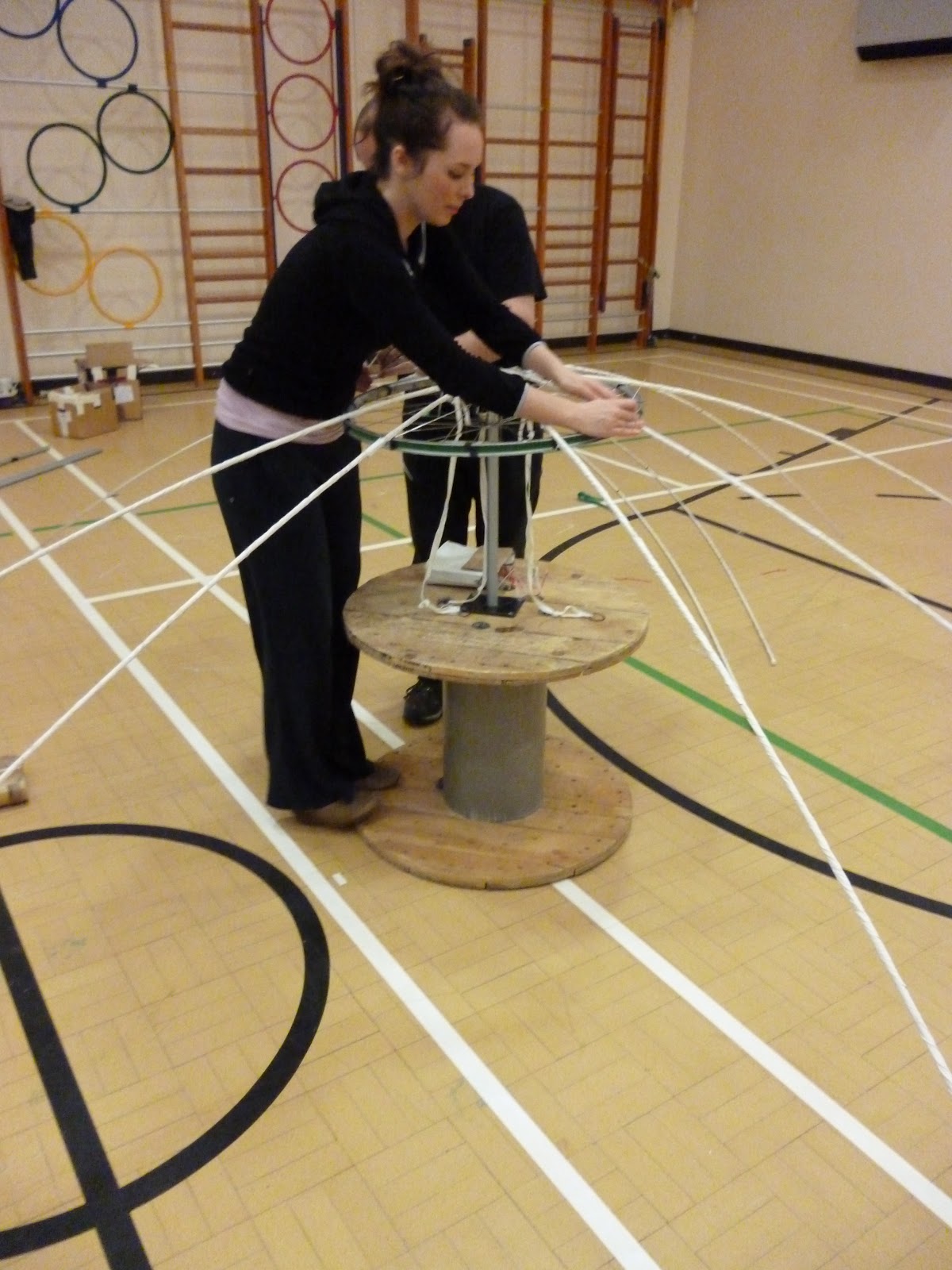
Making props in the Oily workshop with their production team has been especially fun for me. great to be handling power tools and building stuff but also cool to be working on tiny props that are quite detailed but sturdy as they will either be inches away from the kids' noses at the edge of the playboard and/or literally handled by them. Interesting - as with Sensorium's sensory work - to be ever mindful of safety and durability. Also, the reality of of making props in multiples so that all the kids get to physically handle them (the last picture above shows in the foreground the miniature biscuit packets (about 10cm) painstakingly made of foam and shrunk-down photocopied wrappers which became the bane of the props departments' lives since we had to make hundreds of them for the kids to find on the "provisions" hunt over the shows season!). Interesting to note that even a company as well resourced as Oily is heavily reliant in students & volunteers (theatre & design) to produce the sheer volume of props needed. Amanda says this has always been the case for them.(A bit of a relief when I think back to how exhausting it was for me to make almost all the puppets, props and set for The Jub Jub Tree on my own!). Going to have to seriously think about how we could make some kind of volunteerism work for us back home. It's become very apparent that a large part of Oily's success has been due to their commitment to keep the production values as high as possible. Amanda is a very exacting (and enormously talented) designer and the fluidity of ideas between her design ideas andthe directing,  and music of their shows seems to be the key to both the integrity of their Art and the broad appeal and popularity of their output. Talking through production budgets with Oily's lovely lovely full-time production manager, Jesus Gamon, I can see that it's not uncommon for set & costumes (including labour) to make up at least 75% of their budget!! (Hmm... now to convince the money folk back home...).
Francis - Wednesday November 30

Oily Cart impressions - pre-production to tech rehearsal


Very inspiring to be around a company like Oily Cart who have been producing theatre for early years and special needs audiences for over 20 years. Initially we were concerned that the current show they're working on - "Ring A Ding Ding" - wasn't specifically a 'special needs' (pmld - profound and multiple learning disabilities) show, but aimed instead at a general audience of 3-6yr olds (with special needs kids welcome), but observing their rehearsal process and taking in director Tim Webb's narrative & directorial choices and designer Claire de Loon's (aka Amanda Webb) aesthetic decisions has confirmed our suspicions that the overlap between creating work for these two types of audiences can be very strong. 

Just about any review you read about Oily's work talks about how "inventive" they are , and while it's an overused term, it's very very true about this company. 'Ring' takes its design starting point from puppets based on the kind of recycled tin toys made in South Africa that you find at the Oxfam shop,(Amanda collaborated with a South African maker), and so the recycled aesthetic extends to every element of the shows props and sets that we've been helping them make at their workshop headquarters in South London. Stars are made from bottle-tops and the milkman's miniature trolley is literally a plastic bottle-rack-basket on wheels, and when one of the actors transforms into the salty old sea-dog "The Captain", his beard is made from roughly strung together bright orange nylon ropes - like a bristly old broom stuck to his chin...

It's not so much that a completely cohesive design aesthetic is a new concept to me - it's more the notion that every design choice is informed by the same kind of "interactive" imaginary play that kids engage in their own make-believe game-playing with say, shampoo bottles in the bath at home. So, for instance when the audience arrive and are invited to don head pieces made out of pot-scourers or hand-made party hats to watch the show, the party hats are all made from old comic books (and even though they've been expertly made in the workshops to be durable enough to be handled, they look almost as if a kid just rolled up some paper the way you would at home). It's hard to describe it properly - but I guess it's more like having a whole childlike mindset behind whatever it is as a theatre-maker that you're creating.

In this show, the audience of kids sits in a circle  around a large donut-like stage with the 3 main performers in the middle handling puppets and props and placing them literally centimetres away from the kids' noses on the revolving "donut" playboard which swivels around throughout the show (the amazing musician George cycles around the outer perimeter of the audience on his wonderful recycled metal gamelan-style musical instrument bicycle playing the beautiful bell-inspired score by long time Oily collaborating composer Max Reinhart). A hills-hoist-like whirly-gig tree stands in the middle of the stage ring onto which different objects are hooked on and off, and which also swivels around. Thus, a plastic lid with eyes and clothes-peg "beak" flies around on it like a bird. It's not as if I haven't seen skilled puppeteers manipulate found objects to life before, but somehow this performance-mode is less like a "clever" puppeteer turning a mop-bucket into a turtle, and more like my own kids mucking about with household items when they're pretending at home.
Tim told me that actually they mostly don't use puppets in a traditional way - especially in pmld show - (in that way that professional puppeteers give all their focus to the puppet and let the puppet "look at' the audience), because - as we both agreed - most pmld kids respond much more directly to the actor's faces. (Infact, faces are one of the best tools for communication with these audiences).
True inetractivity for the audience is the hallmark of this kind of work - and this company in particular. So for instance, when the main character Alice has to go on a sea voyage to find her lost dog, the actors leave the central donut-stage space and take the kids out of their seats to find "provisions" elsewhere in the theatre for the characters to take on their voyage - or later, when the puppet-ship gets lost in the fog (smoke machines that envelop the whole audience) the Captain gets the audience to help him unfurl a very long rope of bells that the kids pass along the whole circle perimeter of the stage for everyone to join the characters in ringing together to get the ship back to safety through the fog. it's the way the audience is included in the action of the story as active participants rather than just passive recipients that is key. VERY inspiring in terms of future Sensorium shows...

Roger, Oily's general manager, remarked to me that he's never heard Tim say "This shows about X" - so, for instance, with this show, Tim's starting point was simply thinking about how kids experience everything from a physical point of view that's close to the ground - which informed  the subsequent development of this show... Extremely interesting to us as devisors (and particularly to me with my writer's hat on) to think about considering children's physical experiences of their world as a starting point for story-making. Tim later told me that the starting point for their highly successful pmld jazz/blues-infused show 'Blue' actually came from him contemplating the fuzzy blue static screen of an untuned TV set.
Mostly, what I'm getting from all of this is considering new ways of thinking...
Francis - Wednesday November 30

Tuesday, 29 November 2011

November 24th – Under the Sea – with Seeing Beyond – Lucy Garland


Today we journeyed to Sudbury in East Anglia to watch a sensory storytelling session with pmld kids at the Hillside Special School at the invitation of Lucy Garland (Seeing Beyond). www.seeing-beyond.co.uk
Lucy was a colleague of Amber’s who is now based in Norwich.

Under the Sea was a new show that Lucy developed and performed with another colleague Kimberly Moore. The school had “bought” the show for the day and Lucy and Kim set up and performed 3 shows in the space of a day. Lucy and Kim were given lists of names but little other information about the children who were attending. In this case there had not been pre-show preparation.

It was fantastic to see the show and observe the children’s reactions – who obviously loved the show. The show was based around a simple narrative of a young girl, trapped in a hot and smoky city who longs to see the sea – she follows the seagulls who take her to the seaside where she dives in and then is helped by a jellfish who advises her to go inside a bubble and journey deeper under the water.

Observations – Lucy began the show with a simple song that enabled each child to be named and greeted. Pretty much each line of the narrative was accompanied by a-hands on sensory experience. The 2 hander enabled also some visual storytelling to continue while objects and experiences were handled by each child so that there was an alternative focus for children who were not involved in the hands-on experience at the time. Music was also key within the show – with original songs being sung to highlight each point of the narrative. These songs tended to continue while the children were experiencing different elements of the show. After each sensory experience the story point was repeated before moving the story forward.  Eg: Tamara jumped into the water with a splash – then all the children had the opportunity to experience the water mister on their face and hands – after the circle had been completed – the story point was repeated by the performers – Tamara jumped into the water with a splash.

Lucy had experimented with a shadow screen which was a great device for changing scenery and bringing objects out of from behind the screen to the children. She had assembled some wonderful objects and effects – including a section under black light with a glowing fluro coral reef. The children then got to experience the coral reef through the device of a hoop which had tied on fluro material strips that were illuminated by a small black light torch. This was a magical effect. There was also a bowl of glowing sea anemone type balls which each child got to handle. The jellyfish was created using a clear umbrella fringed by long threads which was big enough for each child and a carer to sit within. There was a lovely scene behind the shadow screen which utilised a laser pen and a battery operated fibre optic lamp.

Shadow sillehoutes were used to create a city scape, seagulls flying and various kinds of fishes. These worked really well. I particularly enjoyed the effect of the fishes swimming further and closer with the use of a specific torch behind them. The screen itself had been created by making a small stand up frame with an insertable pull down blind and a overhead projector behind it. Again this was interesting as we had talked about utilising shadow puppetry and screen in our work.

The school itself seemed to be an interesting place and a shame we didn’t get to finish our tour with the deputy Gail. I was particularly struck by their use of a “ Reference Object” outside each door – eg: a wooden cooking spoon on the Kitchen room. Apparently the thinking behind this – is that for some children  having a object with a particular smell, feel and look conveys more powerfully the purpose of the room – than a drawn object  - which for some kids always looks, feels and smells like paper (or laminated paper). The child then has a matching object in a special bag that hangs on the back of their chair and matches their object with the door object when they go to enter a particular room.

In walking and talking with the deputy I was also struck by how progressive their approach was in general and this would support the students to experience new things. In the case of  Lucy’s sensory storytelling – it was her third visit to the school – and none of the children seemed overly  disturbed by the turning off the lights to experience the uV scenes or other events that I might of expected some children to have adverse reactions to.